
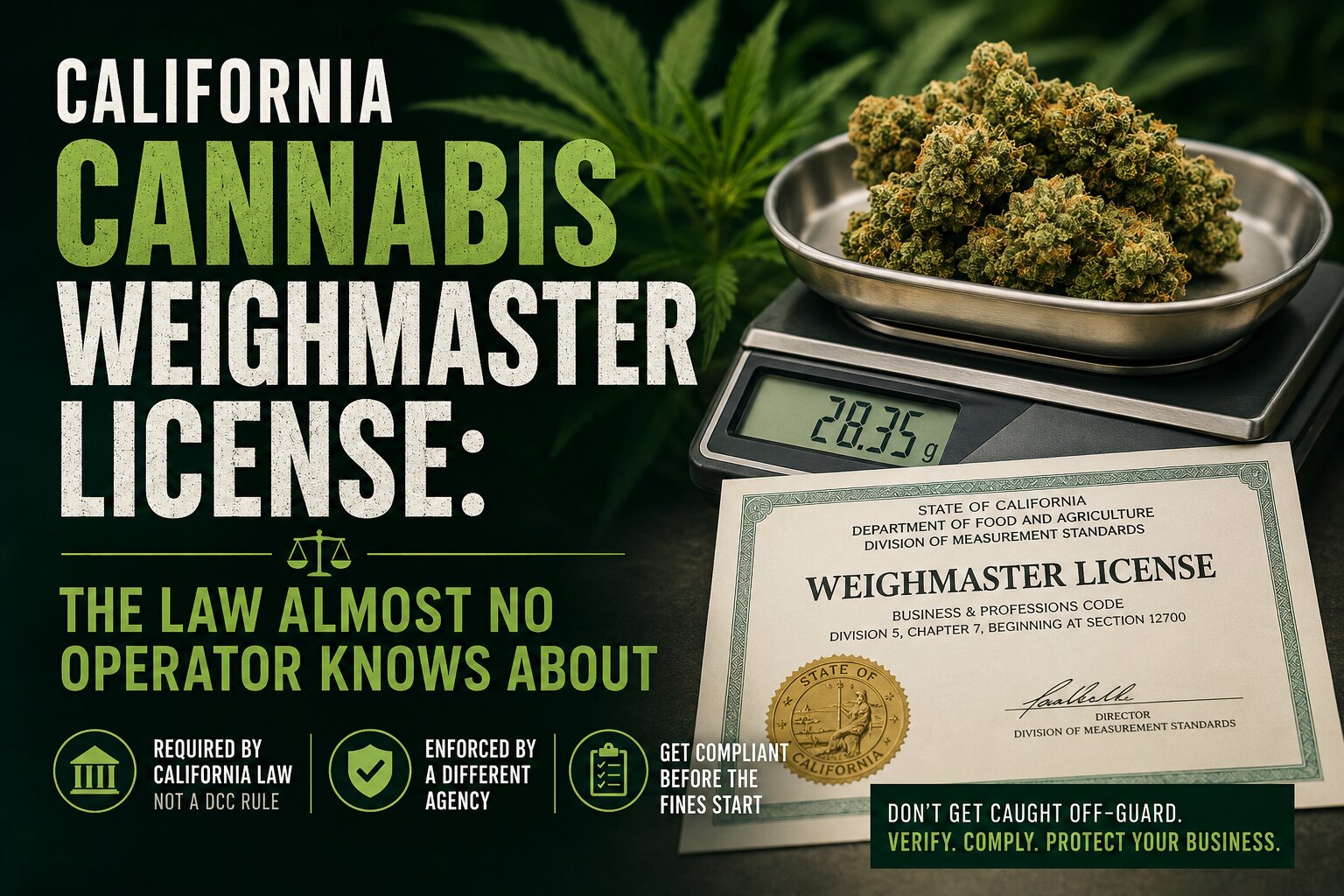
If you weigh cannabis before it ships, California law almost certainly requires you to be a licensed weighmaster — and there's a strong chance you, your distributor, and everyone you transfer with are doing it without one.
This isn't a gray area or an industry rumor. It's written into the California Business and Professions Code, it's enforced by a state agency most cannabis operators have never dealt with, and it applies far more broadly than people realize. The reason almost no one is following it is simple: it lives in a regulatory blind spot — and blind spots are exactly where fines come from.
What a weighmaster license actually is
Under California's weighmaster law (Business & Professions Code, Division 5, Chapter 7, beginning at Section 12700), anyone who weighs, measures, or counts a commodity — and issues a statement of that weight used as the basis for buying or selling — is acting as a weighmaster. Doing that without a license is a violation.
The key detail: this law is not administered by the Department of Cannabis Control. It's administered by the Division of Measurement Standards (DMS) within the California Department of Food and Agriculture (CDFA), and enforced locally by county sealers of weights and measures.
That's the whole problem in one sentence. Your compliance team is watching the DCC. The weighmaster requirement is coming from somewhere else entirely.
Why it applies to cannabis — and to nearly every license type
Cannabis is bought and sold by weight. Every time product is weighed and that weight becomes the basis of a transaction or a transfer manifest, you're squarely in weighmaster territory.
- Distributors are the most exposed — they weigh, package, and create the transfer manifests that move product through the supply chain.
- Cultivators selling by weight, manufacturers transferring bulk material, and anyone generating a weight that drives a sale can fall under it too.
If your operation puts product on a scale and that number leaves your building on a manifest or invoice, you should assume this applies to you until you've confirmed otherwise.
Why almost no one knows
- It's a different agency. Everyone's energy goes to DCC licensing and METRC track-and-trace. Weighmaster sits under CDFA/DMS, so it never comes up in the usual compliance conversations.
- It predates cannabis. Weighmaster law was written for grocers, scrap yards, and produce — long before legal cannabis. Nobody re-introduced it to the industry, so the industry never learned it.
- It's under-enforced — for now. When a rule isn't being actively policed, operators assume it doesn't matter. That assumption holds right up until the first inspection, and then it's an expensive lesson.
The risk: it's not taken seriously until the fines start
Here's the pattern with measurement-standards enforcement: quiet, until it isn't. County sealers conduct inspections, and DMS can act on uncertified weighing, unsealed or uncertified scales, and missing records. When enforcement arrives, "we didn't know" is not a defense — and the exposure compounds, because every uncertified transaction is potentially its own violation.
Add the recordkeeping piece: weighmaster certificates and supporting records must be retained and available for inspection. If you can't produce the records on request, the gap is visible instantly.
The operators who win aren't the ones who react after the first fine. They're the ones who get ahead of it while it's still cheap and quiet to fix.
What compliance actually looks like
Done right, weighmaster compliance is straightforward and inexpensive relative to the risk:
- A licensed weighmaster (and trained weighmaster deputies) responsible for weighing.
- Scales tested and sealed by your county sealer of weights and measures, kept within certification.
- Sequentially numbered weighmaster certificates, each tied to the corresponding transfer or manifest — no skipped or reused numbers.
- The required certifying language included where your manifests and records can show it.
- Records retained and ready for inspection.
None of this slows down a well-run operation. It just has to actually exist, and be documented, before someone asks to see it.
Cover yourself: verify this directly
Don't take our word for it — and don't take anyone else's. The single smartest move you can make today is to contact the California Division of Measurement Standards (CDFA/DMS) or your county sealer of weights and measures directly and ask, in writing, whether your operation requires weighmaster licensing and what your obligations are. Getting that answer on the record is how you protect yourself if enforcement ever comes knocking.
If they confirm it applies to you — and for most operators who weigh product, it will — you'll want a system in place fast.
How weedRx helps
This is exactly what we do. weedRx works with California cannabis operators to:
- Assess whether weighmaster requirements apply to your specific license type and operation,
- Stand up a compliant weighmaster process — licensing, sealed scales, sequential certificates, and audit-ready recordkeeping,
- And implement the tools that make it run automatically alongside your existing METRC and invoicing workflow.
We run this in production ourselves. We're not theorizing about the law — we operate inside it every day.
Get ahead of this before it's a fine, not after. Book a compliance assessment.
This article is for general information and is not legal advice. Weighmaster requirements are governed by the California Business and Professions Code and administered by CDFA's Division of Measurement Standards and county sealers; rules and penalties change. Confirm your specific obligations directly with DMS, your county sealer, or qualified counsel.